
Ask anyone who has opened a sealed shipping container on a humid morning about “container rain” and they’ll know exactly what you mean: water dripping from the ceiling as if it rained inside, even though the container never leaked. It’s condensation, and it’s one of the most common (and most avoidable) problems in container storage and conversions.
Why condensation happens in a closed container
Steel has almost no insulating value on its own, so the roof and walls of an uninsulated container quickly match the outside temperature. When warmer, moisture-laden air inside the box touches that cold steel, the air can’t hold as much water vapor and it condenses right on the ceiling and upper walls. Overnight temperature swings make this worse: warm daytime air gets trapped, then the steel cools rapidly after sunset and condensation forms while the container is sealed up.
Passive ventilation: the simplest fix
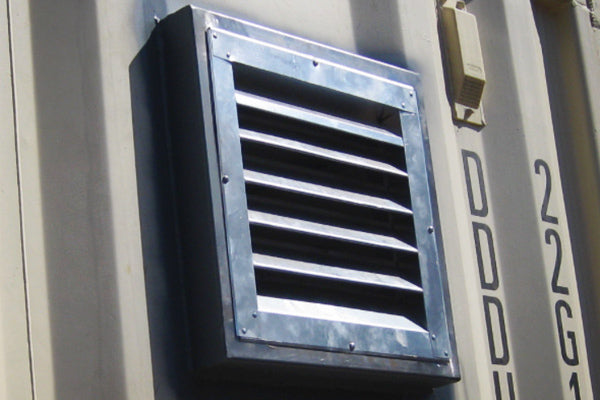
Louvered vents installed near the roofline (and sometimes paired with lower vents) let humid air escape and outside air circulate before moisture has a chance to condense. This is the standard, low-cost fix for storage containers holding goods that can tolerate some humidity swing, and it requires no power source.
When ventilation isn’t enough
For a conversion that will be occupied — an office, cabin, or workshop — passive vents alone usually aren’t enough, especially in humid climates. That’s where insulation (see our insulation guide) does the real work: by keeping the interior wall surface above the dew point, insulation stops condensation from forming in the first place rather than just venting it out after the fact. Active ventilation — a small exhaust fan tied to a humidity sensor — is worth adding to any insulated, occupied build.
Protecting what’s stored inside
If you’re using a container for long-term storage of anything moisture-sensitive — paper records, electronics, wood furniture, or dry goods — combine vents with moisture-absorbing desiccant packs or a small dehumidifier, and avoid stacking items directly against the walls or ceiling where condensation collects first. Pallets under stored goods also help keep anything off a concrete floor that can sweat in humid weather.
Related reading
See our lifespan & maintenance guide for how unmanaged moisture accelerates rust, and our modifications guide for adding vents, windows, or exhaust fans to an existing container. Browse vent kits or get in touch for help specifying a build for your climate.
Building something that needs airflow? See our guides to container workshops and farm & agricultural storage, both of which depend on good ventilation.
Leave a Reply