🚚 Ready to order today? Use code SHIPTODAY50 for $50 off any order — no signup needed. Shop Now

Blog

  • Shipping Container Foundation & Site Preparation Guide

    Shipping Container Foundation & Site Preparation Guide

    A shipping container doesn’t need a foundation the way a house does — it’s a rigid steel box designed to carry its own weight at the corner castings — but the ground underneath it absolutely matters. The wrong site prep leads to a container that sinks unevenly, doors that jam, and water pooling against the walls. Here’s what to prepare before delivery, whichever container size you’re placing.
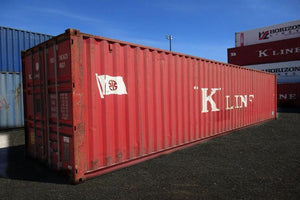
    40ft shipping container placed on a prepared site
    A level, well-drained site keeps a container’s doors, floor, and corner castings square for years.

    Why the ground matters more than a slab

    Containers are engineered to be lifted and stacked using the four corner castings, so nearly all of a container’s weight rests on those eight points (four bottom castings, plus the length of the bottom rail if it’s fully supported). If the ground under any one corner settles, the whole frame can rack slightly out of square, and that’s when doors stop lining up. Good site prep is really about giving those support points — and the rail between them — a stable, level, well-drained surface.

    Option 1: Compacted gravel pad

    The most common and cost-effective foundation is a compacted gravel pad, typically 4–6 inches of crushed stone graded flat and sloped slightly away from the container for drainage. It drains well, resists frost heave better than bare soil, and is inexpensive to install with a rented plate compactor. This is the standard choice for storage, job-site, and rental placements where the container may move again later.

    Option 2: Concrete piers or blocks

    For a more permanent placement, concrete piers poured at each corner (and at the midpoints of longer containers) lift the container off grade-level moisture and provide a precise, unmovable level surface. This is a common choice for container homes, offices, and cabins that will stay in place for years, since piers also make it easier to run utilities underneath the unit.

    Option 3: Full concrete slab

    A full slab is the most expensive option but makes sense for permanent installations, multi-container builds, or anywhere the container will be tied down structurally (high-wind zones, for example). A slab also gives you a finished, level surface right up to the container’s footprint, which is useful for buildings that will be walked in and out of frequently.

    What to check before delivery day

    Whichever foundation you choose, confirm ground clearance and access for delivery equipment beforehand. Delivery trucks generally need overhead clearance and enough straight-line room to slide the container off the trailer bed. See our delivery process guide for exact clearance requirements, and check local zoning and permit rules before you pour anything permanent.

    Related reading

    Once the site is ready, decide how the container itself needs to be finished — see our insulation guide and modifications guide. For sizing help, check container dimensions, and reach out for a delivery quote once your site is graded and ready.

    Planning a placement? See our guides to containers for storage, construction site containers, and portable storage for business for use-case-specific site tips.
  • Shipping Container Insulation Options: Complete Guide

    Shipping Container Insulation Options: Complete Guide

    A bare steel shipping container is a great structure and a terrible thermal envelope. Without insulation, an uninsulated box can swing from freezing overnight lows to well over 120°F inside on a sunny afternoon, and condensation (“container rain”) will form on the ceiling as warm, moist air meets cold steel. If you’re converting a container into an office, cabin, or workshop, insulation is the single upgrade that makes the space usable year-round.

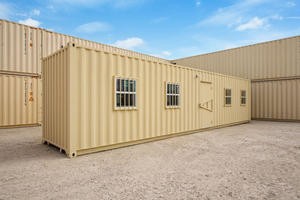
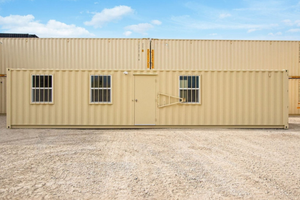
    Insulated shipping container office with siding
    An insulated, sided container office keeps interior temperatures stable in any climate.

    Why steel containers need insulation

    Steel is highly conductive, so a container’s walls transfer outside temperature straight to the interior almost instantly. Insulation slows that transfer and, just as importantly, keeps the interior air warmer than the steel skin’s dew point so moisture doesn’t condense on the ceiling and drip onto whatever is stored below. Any conversion meant for people, electronics, or moisture-sensitive inventory should be insulated before anything else is built out.

    Spray foam insulation

    Closed-cell spray polyurethane foam is the most common choice for container conversions. It’s sprayed directly onto the interior steel, expanding to fill every rib and seam with no gaps for moisture to sneak through. At 2–3 inches thick it delivers roughly R-13 to R-20, and because it bonds to the steel it also adds a layer of corrosion resistance on the inside face. It’s a good fit for offices, cabins, and workshops where interior wall thickness loss (a few inches per side) isn’t a concern.

    Rigid foam panel insulation

    Rigid polyisocyanurate or XPS panels are cut to fit between furring strips and fastened to the container walls. Panels are less expensive per square foot than spray foam and easier to source locally, but seams need to be taped or foamed to stop air leaks, and they don’t provide the same moisture-sealing performance as a monolithic spray-foam layer. Panels work well for budget builds and DIY projects where a contractor isn’t spraying foam on-site.

    Insulated siding and pre-built options

    For a turnkey approach, many buyers choose containers that already come insulated and sided from the factory, like our insulated office with siding. These units pair interior spray foam with an exterior siding layer that also protects the paint and adds a residential look, which is useful if the container will sit somewhere visible rather than at the back of a job site.

    Which R-value do you actually need?

    For an occasionally-used workshop or storage-adjacent office, R-13 spray foam is usually enough. For a container that will be lived in or run HVAC year-round, aim for R-19 or higher, which typically means thicker spray foam plus a service cavity, or foam panels combined with a mineral wool layer. Climate matters too — a container home in a northern climate needs meaningfully more insulation than the same build in the Gulf Coast.

    Related reading

    Insulation is one piece of a larger conversion. See our modifications guide for what else can be cut, added, or reinforced, our electrical wiring basics guide for powering an insulated build, and new vs. used containers if you’re still deciding on a base unit. Ready to spec out a build? Financing options are available, and our team can help you pick the right container for insulation from day one.

    Shopping for an insulated build? See our container offices for sale and homes & cabins for sale — both come with insulation already factored into the build.

    Choosing HVAC equipment? See our heating & cooling options guide.

  • Importing a Shipping Container: Customs & Regulations by Country

    Importing a Shipping Container: Customs & Regulations by Country

    Buying a shipping container from a U.S. exporter and having it delivered internationally means the container clears customs in your country before it reaches you. The paperwork is more predictable than it sounds — here’s the general process, and where to find country-specific notes.

    The Documents Involved

    • Commercial invoice — states the container’s value, used for calculating any duty or import tax owed
    • Bill of lading — the ocean carrier’s shipping document, proof of what’s being transported and to where
    • Packing list — describes the container itself (size, condition grade, any accessories)
    • Import declaration — filed with your country’s customs authority, often through a licensed customs broker

    We prepare the export-side documentation (commercial invoice, bill of lading) for every international order — you or your customs broker handle the import declaration on the receiving end.

    Duties and Import Tax Vary by Country

    Whether a used shipping container owes import duty, and at what rate, depends entirely on your country’s customs classification and current trade rules — we don’t publish a general duty rate because it varies too much to be reliable. What’s consistent everywhere: your customs broker or authority will classify the container by its HS (Harmonized System) code and assess any duty or import VAT/GST based on the commercial invoice value we provide.

    Working With a Customs Broker

    For anything beyond a small parcel, most buyers use a licensed customs broker to file the import declaration rather than doing it themselves — this is standard practice, not a sign of a complicated shipment. Freight forwarders and customs brokers at your destination port can usually quote their clearance fee before the container arrives, so it’s worth confirming that separately from our export quote.

    Country-Specific Notes

    We’ve published country-specific guides with import notes for several of our common export destinations, including Ireland, Singapore, New Zealand, the UAE, South Africa, and EU/EEA markets including Portugal, Poland, Sweden, Belgium, and Norway. If your destination isn’t listed, request a quote and we’ll walk you through what documentation your country typically requires.

    Request an Export Quote

    Tell us your delivery country and we’ll confirm container availability, export documentation, and estimated freight cost to your nearest port.

    Related Articles

    Shipping Container Zoning & Permit Basics

  • Are Shipping Containers a Good Investment? Resale Value Explained

    Are Shipping Containers a Good Investment? Resale Value Explained

    Shipping containers hold their value better than most equipment, but they’re not an appreciating asset the way real estate can be — think of buying one as locking in a usable structure at a fixed cost rather than a speculative investment. Here’s what actually drives resale value if you’re weighing the decision.

    What Holds Container Value Up

    • Steel scrap value acts as a floor — even a badly worn container is worth something for its raw steel, which limits how far resale value can fall
    • Condition grade at purchase — a Cargo-Worthy or New/One-Trip unit depreciates more slowly than an As-Is unit, since it started in better shape
    • Regional demand — resale value is stronger in areas with active construction, storage, or export demand for used containers
    • Unmodified units resell easier — heavy modification (cut walls, removed sections) narrows the pool of buyers to those wanting exactly that conversion

    What Actually Lowers Resale Value

    • Rust that’s progressed past the surface into structural steel
    • Non-standard modifications that limit reuse for shipping or standard storage
    • Long-term outdoor placement without maintenance — see our lifespan and maintenance guide for what extends usable life

    The Realistic Way to Think About It

    For most buyers, the real return isn’t resale appreciation — it’s avoiding rental or storage-unit costs over time by owning instead. If you’re specifically weighing rent vs. buy, our renting vs. buying guide walks through that comparison. If you do eventually resell, buying a well-graded, unmodified container and maintaining it is what protects resale value most — not the size or brand you choose.

    For current buy pricing by size and condition, see our pricing guide.

    Related Articles

    How Long Do Shipping Containers Last?
    Renting vs. Buying a Shipping Container
    Shipping Container Modifications: What’s Possible

  • Shipping Container Weight Limits & Load Capacity

    Shipping Container Weight Limits & Load Capacity

    Every shipping container has a maximum gross weight rating set by international shipping standards — the combined weight of the container itself (tare weight) plus whatever it’s carrying (payload). Here’s what those standard ratings actually are, and what they mean if you’re loading, moving, or placing a container.

    Standard Weight Ratings by Size

    These are the typical ISO-standard ratings manufacturers certify containers to — always check the CSC (Convention for Safe Containers) plate on the actual unit’s door for its exact certified rating, since it can vary slightly by manufacturer and container age:

    • 20ft standard — tare weight around 4,900–5,100 lbs (2,200–2,300 kg); max gross weight around 52,900 lbs (24,000 kg); max payload roughly 47,900 lbs (21,700 kg)
    • 40ft standard — tare weight around 8,400–8,600 lbs (3,800–3,900 kg); max gross weight around 67,200 lbs (30,480 kg); max payload roughly 58,600 lbs (26,600 kg)
    • 40ft High Cube — similar max gross weight to standard 40ft, with slightly higher tare weight due to the extra height, so slightly less rated payload

    What This Means Outside of Shipping

    If you’re using a container for storage, a conversion, or as a foundation for a build, the max gross rating matters less than how the load is distributed. Containers are engineered to carry their rated weight through the corner castings and bottom rails — not through the floor or roof directly. A few things to keep in mind:

    • Point loads (a vehicle lift, heavy machinery, water tank) need to be positioned over the floor’s structural cross-members, not just anywhere on the plywood floor
    • Stacking containers relies on the corner castings lining up — off-center stacking isn’t rated the same as standard stacking
    • Roofs are rated for snow/rain load, not for foot traffic or equipment unless specifically reinforced

    Delivery Weight Considerations

    An empty container’s tare weight is also what determines what equipment can lift and deliver it. Our delivery process accounts for this automatically — see our delivery day guide for how placement works on your site.

    Related Articles

    Shipping Container Sizes: Complete Dimensions Guide
    Shipping Container Modifications: What’s Possible
    How Long Do Shipping Containers Last? Lifespan & Maintenance Tips

  • Shipping Container Modifications: What’s Possible

    Shipping Container Modifications: What’s Possible

    Cutting doors, adding windows, insulating, and running electrical are all common shipping container modifications — but not every cut is safe without reinforcement, and not every buyer wants to DIY the work. Here’s what’s realistic, what needs engineering, and how to decide between modifying a container yourself or buying one already converted.

    Common Modifications

    • Doors and windows — cut into the corrugated walls (not the corner posts or rails) and typically framed with steel tubing to restore the strength lost when steel is removed
    • Insulation and interior finishing — spray foam, rigid panel, or batt insulation plus interior wall paneling, common for offices, cabins, and livable conversions
    • Electrical and plumbing rough-in — wiring, outlets, lighting, and in some conversions plumbing for a bathroom or kitchenette
    • HVAC — wall-mount mini-splits or through-wall units, since containers have no natural ventilation once sealed and insulated
    • Roll-up or French doors replacing the standard cargo doors for easier access
    • Paint and rust treatment — cosmetic refinishing, often paired with structural repairs on used units

    What Needs Engineering, Not Just a Grinder

    A container’s strength comes from its corner posts, top and bottom side rails, and the corrugated wall panels acting together. Cutting a large opening — a garage-door-sized wall, multiple windows in one panel, or removing a full end wall — can compromise that structure unless it’s reinforced with additional steel framing. Any modification larger than a standard door or window cutout is worth having reviewed by someone with container-conversion experience before you cut.

    Buy Pre-Modified or Modify Your Own

    If you want a livable or work-ready space without managing the fabrication yourself, browse our Container Cabins & Tiny Homes category, including the 53ft Retreat Cabin, for units that already have the cutting, framing, and finishing done. If you’d rather modify a raw container yourself, start with a Cargo-Worthy or Wind and Watertight unit rather than As-Is — see our new vs. used condition grade guide for what each grade means for a conversion project.

    Check Local Rules Before You Cut

    If the modified container will be a permanent structure — a cabin, office, or accessory building — check placement and permit requirements before you start cutting. See our zoning & permit basics guide for what to ask your local building department.

    Related Articles

    New vs. Used Shipping Containers: Which Should You Buy?
    Shipping Container Zoning & Permit Basics
    Shipping Container Weight Limits & Load Capacity
    Shipping Container Insurance: Do You Need It?

    Planning a towable modification? See our gooseneck & towable containers guide.

  • 中古コンテナ購入と日本への輸出:横浜

    中古コンテナ購入と日本への輸出:横浜

    中古の海上輸送コンテナをお探しですか、または日本への配送でコンテナを購入したいですか?Container Depot Directは、米国内のデポから新品・中古のコンテナを横浜港へ直接輸出しており、明確な状態評価と、頭金前の確定価格を提供しています。

    日本のお客様が当社を選ぶ理由

    日本はコンテナの多くを海外のデポから輸入しており、お客様は現地では必ずしも得られない在庫の豊富さと明確な状態評価を理由に当社を選んでいます:

    • 10フィート、20フィート、40フィートの標準・ハイキューブコンテナの豊富な在庫
    • 明確な状態グレード(Cargo-Worthy、Wind and Water Tight、新品/一回輸送)により、購入する内容を正確に把握できます
    • モバイルオフィス、建設用コンテナ、コンテナハウス建築に適したコンテナ

    日本へ発送されるコンテナは、輸入港での標準的な税関手続きと輸入消費税の対象となります — 輸出書類は当社側で準備しますので、お客様側の手続きはシンプルです。

    日本のお客様に人気のコンテナタイプ

    保管用コンテナ、モバイル建設オフィス、コンテナハウスへの改造が最も多いご注文です。53ft Retreat Cabinをご覧いただくか、Container Cabins & Tiny Homesの全ラインナップをご覧ください。

    輸出プロセスの流れ

    1. コンテナサイズ、状態グレード、必要な改造を選択します
    2. 最寄りの日本の港への輸出見積もりをご依頼ください — 海上運賃を含む総額を確認します
    3. 承認後、デポからの集荷を手配し、輸出書類を準備します
    4. 港への輸送および最終配送を追跡し、決定前に配送スケジュールを確認します

    お見積もりのご依頼

    日本への詳細な輸出見積もりをご依頼ください — ご注文前に価格、状態グレード、配送スケジュールを確認いたします。

    関連記事

    2026年の海上コンテナの価格はいくら?価格ガイド
    新品 vs 中古:どちらを買うべきか?
    コンテナの輸入:国別の税関と規制

  • Comprar Contenedor Marítimo con Exportación a México: Manzanillo

    Comprar Contenedor Marítimo con Exportación a México: Manzanillo

    ¿Buscas un contenedor marítimo usado o quieres comprar un contenedor con entrega en México? Container Depot Direct exporta contenedores nuevos y usados desde nuestro depósito en Estados Unidos directamente al puerto de Manzanillo, con evaluación de estado transparente y un precio fijo antes del depósito.

    Por qué los clientes mexicanos compran con nosotros

    México importa una parte importante de sus contenedores desde depósitos extranjeros, y los clientes nos eligen por la disponibilidad y la evaluación de estado clara que no siempre se encuentra localmente:

    • Amplio inventario de contenedores estándar y high cube de 10, 20 y 40 pies
    • Grados de condición claros (Cargo-Worthy, Wind and Water Tight, Nuevo/un solo viaje) para que sepas exactamente qué compras
    • Contenedores adaptados para oficinas móviles, contenedores de obra o construcción de casas contenedor

    Los contenedores enviados a México pasan por el proceso estándar de aduana mexicana e IVA de importación en el puerto de entrada — nosotros preparamos la documentación de exportación de nuestro lado para que el proceso sea sencillo para ti.

    Tipos de contenedores más solicitados en México

    Los contenedores de almacenamiento, las oficinas móviles de obra y las conversiones a casas contenedor son los pedidos más comunes. Consulta nuestra 53ft Retreat Cabin o explora el catálogo completo de Container Cabins & Tiny Homes.

    Cómo funciona el proceso de exportación

    1. Elige el tamaño del contenedor, el grado de condición y las modificaciones que necesites
    2. Solicita una cotización de exportación al puerto mexicano más cercano — confirmamos el precio total incluyendo el flete marítimo
    3. Una vez aprobada, coordinamos la recolección desde el depósito y gestionamos la documentación de exportación
    4. Da seguimiento a tu envío hasta el puerto y la entrega final, con un tiempo de entrega confirmado antes de que decidas

    Solicita tu cotización

    Solicita una cotización de exportación detallada a México — precio, grado de condición y tiempo de entrega confirmados antes de ordenar.

    Artículos Relacionados

    ¿Cuánto Cuesta un Contenedor Marítimo en 2026? Guía de Precios
    Nuevo vs. Usado: ¿Qué Contenedor Comprar?
    Importar un Contenedor: Aduanas y Regulaciones por País

  • Kjøp Sjøfraktscontainer med Eksport til Norge: Oslo

    Kjøp Sjøfraktscontainer med Eksport til Norge: Oslo

    Ser du etter en brukt sjøfraktscontainer eller vil kjøpe en container med levering til Norge? Container Depot Direct eksporterer nye og brukte containere fra vårt lager i USA direkte til Oslo havn, med tydelig tilstandsvurdering og fast pris før forskudd.

    Hvorfor norske kunder velger vårt lager

    Norge henter en betydelig del av containerne sine fra utenlandske lagre, og kunder velger oss for tilgjengelighet og tydelig tilstandsvurdering som ikke alltid finnes lokalt:

    • Stort lager av standard- og high cube-containere i lengdene 10, 20 og 40 fot
    • Tydelige tilstandsklasser (Cargo-Worthy, Wind and Water Tight, Ny/enkelttur) så du vet nøyaktig hva du kjøper
    • Containere tilpasset mobile kontorer, byggecontainere eller containerhus-konstruksjon

    Som medlem av EØS, men utenfor EU, går containere som sendes til Norge gjennom norsk tollbehandling og innførsels-mva ved ankomsthavnen — vi forbereder eksportdokumentasjonen fra vår side, slik at prosessen blir enkel for deg.

    Vanligste containertyper for norske kunder

    Lagringscontainere, mobile byggekontorer og ombygging til containerhus er de vanligste bestillingene. Se vår 53ft Retreat Cabin eller bla gjennom hele utvalget av Container Cabins & Tiny Homes.

    Slik fungerer eksportprosessen

    1. Velg containerstørrelse, tilstandsklasse og eventuelle modifikasjoner
    2. Be om et eksporttilbud til nærmeste norske havn — vi bekrefter totalpris inkludert sjøfrakt
    3. Etter godkjenning planlegger vi henting fra lageret og ordner eksportdokumentasjonen
    4. Følg forsendelsen din til havnen og sluttleveringen, med bekreftet leveringstid før du bestemmer deg

    Be om ditt tilbud

    Be om et detaljert eksporttilbud til Norge — pris, tilstandsklasse og leveringstid bekreftet før du bestiller.

    Relaterte artikler

    Hva Kostet en Sjøfraktscontainer i 2026? Prisguide
    Nye vs. Brukte Containere: Hvilken Bør Du Kjøpe?
    Importere en Container: Toll og Regler per Land

  • Zeecontainer Kopen met Export naar België: Antwerpen

    Zeecontainer Kopen met Export naar België: Antwerpen

    Op zoek naar een gebruikte zeecontainer of wil je een zeecontainer kopen met levering in België? Container Depot Direct exporteert nieuwe en gebruikte containers vanuit ons depot in de Verenigde Staten rechtstreeks naar de haven van Antwerpen, met duidelijke conditiebeoordeling en een vaste prijs vóór aanbetaling.

    Waarom Belgische klanten bij ons bestellen

    België haalt een groot deel van zijn containers uit buitenlandse depots, en klanten kiezen voor ons vanwege de beschikbaarheid en duidelijke conditiebeoordeling die niet altijd lokaal te vinden is:

    • Ruime voorraad standaard- en high cube-containers van 10, 20 en 40 voet
    • Duidelijke conditieklassen (Cargo-Worthy, Wind and Water Tight, Nieuw/één reis) zodat je precies weet wat je koopt
    • Containers geschikt voor mobiele kantoren, bouwcontainers of containerwoningen

    Als EU-lidstaat doorlopen containers die naar België worden verzonden de standaardprocedure voor douane en EU-invoer-btw bij de haven van binnenkomst — wij bereiden de exportdocumentatie van onze kant voor, zodat het proces voor jou eenvoudig blijft.

    Meest bestelde containertypes in België

    Opslagcontainers, mobiele bouwkantoren en ombouw tot containerwoningen zijn de meest voorkomende bestellingen. Bekijk onze 53ft Retreat Cabin of blader door het volledige aanbod Container Cabins & Tiny Homes.

    Zo werkt het exportproces

    1. Kies containerformaat, conditieklasse en eventuele aanpassingen
    2. Vraag een exportofferte aan naar de dichtstbijzijnde Belgische haven — wij bevestigen de totaalprijs inclusief zeevracht
    3. Na goedkeuring plannen we de afhaling vanuit het depot en verzorgen we de exportdocumentatie
    4. Volg je zending naar de haven en de eindlevering, met een bevestigde levertermijn voordat je beslist

    Vraag je offerte aan

    Vraag een gedetailleerde exportofferte naar België aan — prijs, conditieklasse en levertermijn bevestigd voordat je bestelt.

    Gerelateerde artikelen

    Wat Kost een Zeecontainer in 2026? Prijsgids
    Nieuwe vs. Gebruikte Containers: Welke Moet Je Kopen?
    Een Container Importeren: Douane en Regelgeving per Land